As Furry Conventions Grow, Our Expectations Need to Change
Furry conventions depend on volunteers giving extraordinary amounts of their time. As our events grow, we need to ask when that generosity becomes something our conventions depend on.
 Gomi Deer
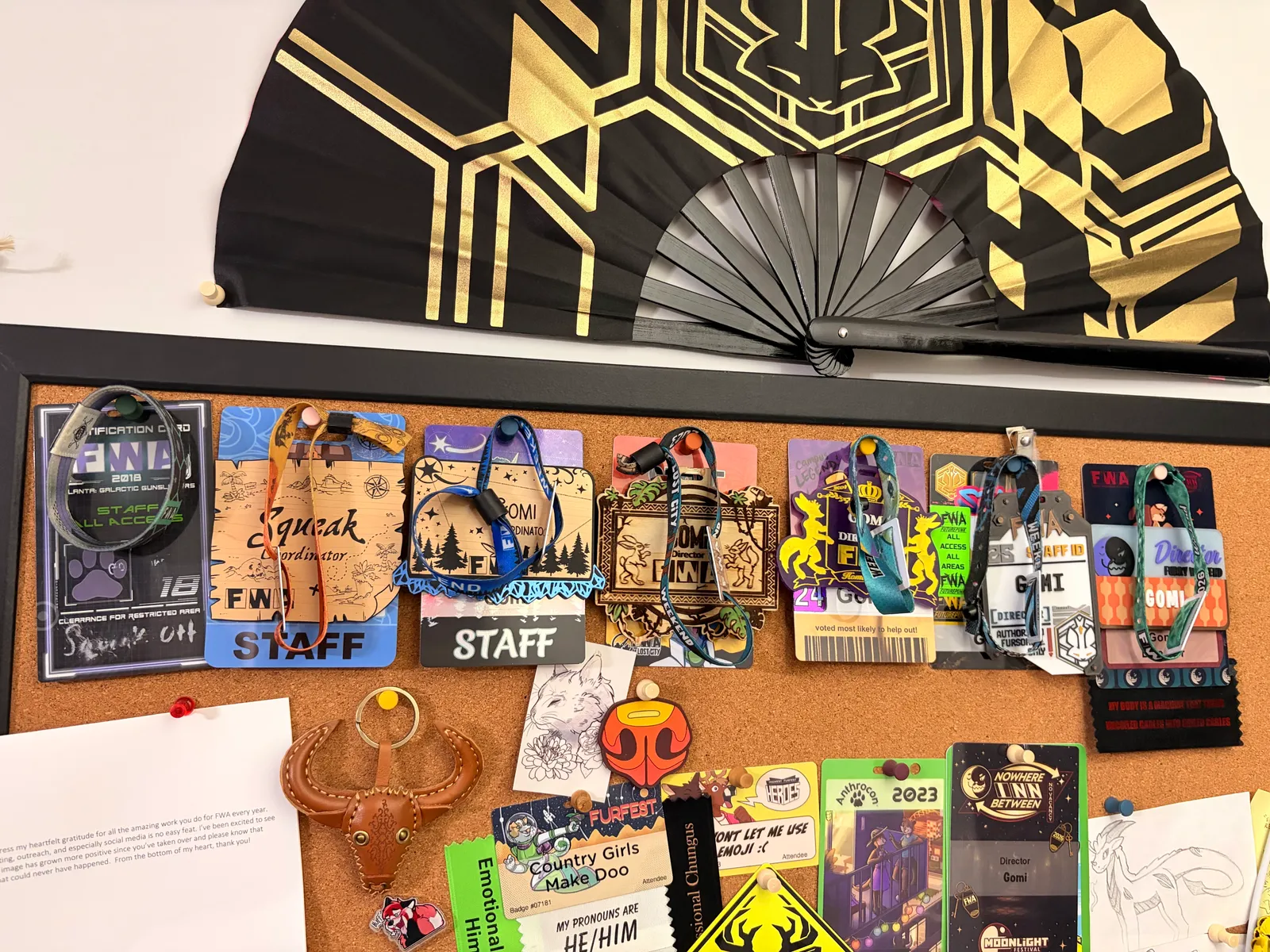
 A little context about me: I’ve spent nearly a decade volunteering with Furry Weekend Atlanta, including several years in upper leadership as a director. In July of 2026, I stepped down from that role because of the stress I discuss in this post. My experience comes primarily from FWA, but I’ve also spent years working with and talking to people involved in running other furry conventions.
At a convention I went to recently I ran into someone I knew on staff Friday morning of the con. I stopped to talk to them, and almost immediately they pulled me aside from the group of staff they were with.
They were overwhelmed and needed someone to listen to them that wasn’t also working the con. As they told me about some of the things they were dealing with, they started to break down, nearly coming to tears right there on the convention floor.
I don’t want to get into the specifics of what they told me. It’s not my story to tell. But I knew what they were feeling. I would be lying if I said I hadn’t had some pretty rough cries during FWA myself.
I’ve seen people struggle under the amount of work and responsibility they’ve taken on for furry conventions before. Seeing someone break down like that so soon after hitting my own burn-out, though, was a large part of what pushed me to write this.
As conventions grew, so did the work
Furry conventions grew out of volunteer communities, and volunteering is still one of the things that makes them special.
When a convention is small, the simple volunteer model makes a lot of sense. You have a group of furries who want to throw a small weekend con for their friends and local community, so everyone pitches in and grabs whatever needs to be done. Someone handles registration. Someone gets a hotel block. Someone organizes programming. People show up, have a great weekend, and then everybody goes back to their normal lives.
But conventions don’t stay that way as they grow.
Some of our largest conventions now operate across multiple hotels and venues, with complicated contracts and vendor relationships, hundreds of volunteers, and thousands upon thousands of attendees. Attendees expect more too: reliable registration, safety plans, accessibility policies, good programming, and people who can help when something goes wrong. Those are reasonable expectations. A large convention has responsibilities to the people attending it.
Most of the people doing the work, though, are still volunteers, fitting it around their actual jobs and the rest of their lives, often throughout the entire year, unpaid.
There’s nothing wrong with someone choosing to give an extraordinary amount of their time to something they love. The problem is when the convention comes to depend on them continuing to do it.
That’s the part I don’t think we’ve adjusted to as a community. The conventions changed, and the amount of work required to run them grew with them. Volunteers kept picking up that work as it appeared, and over time, what used to be an extraordinary amount for someone to give became a normal part of keeping these events running. Nobody sat down one day and decided that convention staff should give an ever-increasing amount of their lives to these organizations. It happened a little at a time.
When you feel like you can’t quit
There’s an assumption that makes volunteer organizations work: if somebody doesn’t want to do a job anymore, somebody else can volunteer to do it.
That gets harder, though, when the job has turned into hundreds of hours of work, year-round responsibilities, stressful decisions, and being the person everybody looks to when something goes wrong. There may be plenty of people capable of doing the work and who care about the convention, but that doesn’t mean they have room in their lives to take it on.
Eventually, you can end up with someone who desperately wants to step away and nobody who can realistically replace them. Maybe work needs more of your attention. Maybe your relationship does. Maybe you’re just tired and realize that you can’t keep giving the convention this much of your life.
But if you leave, who’s going to keep doing the work that the thing you’ve spent years helping build now depends on?
Nobody necessarily has to tell you that you can’t quit. You already know what isn’t going to get done if you leave. You know the other volunteers around you are carrying plenty themselves. And, usually, you care about the thing you’ve spent years helping build.
From the outside, “someone else will step up” sounds simple. When you’re actually trying to hand off the role, you know that the people who could replace you have jobs and relationships and lives too.
So you tell yourself you’ll stay just one more year. Or through one more convention. Or you’ll leave once you’ve trained somebody to replace you, except the right person never quite appears and there’s always another convention coming.
I say these things because I experienced them. After years in FWA leadership, I knew the amount of work I was doing wasn’t sustainable for me. Yet I stayed in the role much longer than I should have because I didn’t want to let the volunteers around me, and FWA’s attendees, down.
After last FWA, though, I finally stepped down as a director and moved into a staff role because I was long past being burnt out.
I still cared about FWA. I still wanted to contribute. I just couldn’t live up to my own expectations anymore when it came to doing my job.
I know that stepping down didn’t make the work I was doing disappear. It had to be picked up by the people around me, the same people I’d spent years trying not to overburden in the first place. I know my leaving put more work on some of them, and I still feel guilty about that, even though I know it’s unfair to myself to feel that way.
FWA didn’t tell me I had to treat being a director like a full-time job. Much of that pressure came from expectations I’d internalized about what the convention needed from me, what attendees reasonably expected from FWA, and what I expected from myself.
A job description doesn’t tell you everything a person feels responsible for. Eventually, what the organization needs, what other volunteers rely on you to do, and the standards you’ve set for yourself can add up to more than one volunteer can reasonably carry. And when it does, finding another volunteer to carry the same load doesn’t fix the underlying problem.
I don’t think there’s a villain here. Convention boards didn’t decide their staff should spend ridiculous amounts of their free time on these events, and attendees aren’t wrong for expecting a convention they paid to attend to be competently run. A lot of this just happens through growth. You do that for ten or twenty years and one day you find yourself more overloaded than you ever expected.
It also becomes harder to see as conventions get larger. At a small event, it’s easy to see the convention as something a group of people from the community got together and built. At a large one, hundreds of staff can start to feel like just another fixture of the event.
A lot of the work happens when attendees aren’t there to see it. It happened six months ago on a Tuesday night after somebody got home from work. It’ll happen again two weeks after the convention when everyone else has gone home. The person handing you a badge at registration is doing important work. So are the people who spent the previous year making sure the system was ready to produce it.
When something goes wrong, we see the thing that went wrong. We don’t see all the things that didn’t go wrong because somebody spent hours making sure they wouldn’t.
Being volunteer-run doesn’t excuse conventions when they fall short. But the standards we reasonably expect from these events don’t exist separately from the volunteer labor required to meet them.
We need to change what we expect from volunteers
When we call someone a volunteer, that should mean something.
A volunteer should be able to say, “I can’t do this right now.”
They should be able to go on vacation and actually be on vacation. They should be able to have a bad month at work and give the convention less time. If there’s a family emergency, or they want to spend more time on another hobby for a while, the convention should be able to absorb that. And eventually, they need to be able to leave.
Allowing volunteers to have those boundaries also means accepting what happens when they use them. Something might take longer. Something might need to be smaller. Something we want to do might not happen at all. We can’t say volunteers should be able to give less of themselves when they need to while also assuming that everything they were doing will somehow continue unchanged.
Those of us on staff, and especially those of us in leadership, also need to look at the expectations we put on ourselves. Not every expectation comes from the organization, attendees, or the people around us. Sometimes we’re the ones setting an unreasonable standard for ourselves.
But the standards we set for ourselves don’t always stay our own. The way we work helps set the culture of the organizations we’re part of. If the person leading a department is constantly available and gives every free hour they have to the convention, the people around them can start to feel like that’s what being committed looks like too.
We have to be willing to model the limits we want other volunteers to be allowed to have.
”Just make the roles smaller” isn’t easy either
One response to all of this might be that conventions simply need to spread the work around better. And I agree.
But if a position has accumulated too much responsibility, somebody has to figure out how to break it apart. They need to document things that may have lived in one person’s head for years, recruit and train people, hand off relationships, and figure out who owns what afterward. Usually, the people who need to do that are already the people who don’t have enough time.
Everybody might agree that a role is too big. Fixing the role is still another project, and meanwhile the next convention isn’t waiting. So you get through the convention first. Then everyone is exhausted. Life catches up with them, and before long the next year’s deadlines start showing up. I’ve seen how easy it is for “we need to fix this after the con” to become “we need to fix this after the con after that.” Hell, we even have a running “That’s a June problem” joke at FWA.
Making these organizations more sustainable takes time, and the people who most need things to change are often the people with the least time available to change them. That doesn’t mean restructuring isn’t worth doing. But we can’t treat it as an easy answer to a problem that took years to develop.
Most of my experience is with FWA, and furry conventions aren’t all run the same way. But I’ve talked to enough people in leadership at FWA and elsewhere to know I’m not the only person who’s looked at the amount of convention work in front of them and wondered how much longer they could keep doing it. I don’t think it’s fair for us to ask people from our community to live like that for our benefit. And I worry about how long these incredible events that let us see some of our closest friends multiple times a year will continue to exist if we don’t stop to think about this.
What I’m actually asking for
I’m not asking furry conventions to stop growing, attendees to stop expecting conventions to be well run, or people to stop volunteering.
I’m asking the furry community, both as convention staff and attendees, to reconsider an assumption we have: that no matter how large, complicated, or ambitious our conventions become, the people responsible for making them happen will somehow continue finding enough time in the rest of their lives to do whatever is necessary.
What do we actually expect from the people running our conventions? Have we come to expect professional levels of work from people we’re expecting to do that work in their spare time?
Are we giving volunteers room to say, “I can’t do this right now”? And when something doesn’t get done, are we willing to accept that sometimes the answer may simply be that nobody had the time to do it?
Are we building organizations that depend on people volunteering, or have we become dependent on people sacrificing?
And then there’s one of the hardest questions: when does a role ask enough of someone that we need to consider whether it should be compensated? I don’t think that’s the first question we should reach for, but I do think it needs to be one we’re eventually willing to ask.
The expectations I’m talking about don’t come from any one group of the furry convention culture, and changing them can’t be the responsibility of any one group either. I don’t think furries have intentionally taken advantage of how much convention staff care about these events. But I do think we’ve gotten used to depending on that care, and that’s the part I think we need to change.
Our conventions have grown into something incredible.
Now our expectations of the people running them need to grow too.
- Gomi
I wrote a follow-up to this post that you can read here.