I Wouldn't Take It Back
I’ve written about what convention staffing can take from people. This is about what it gave me, and why making the work healthier shouldn’t mean making it matter less.
 Gomi Deer
 This is a follow-up to a post I wrote a few days ago. You don’t need to read it first but I think it helps.
Last week, I wrote about how much furry conventions ask of the people who run them.
I wrote about burnout, about the expectations we put on volunteers, and about how easy it is for giving too much of yourself to become normal when everyone around you is doing the same thing. I meant all of it.
But talking about what this work took from me without talking about what it gave me doesn’t feel complete either.
I know I gave FWA more of myself than I should have. I think my last post made that pretty clear.
But I don’t look back at my time with FWA angry at the convention, or angry at myself for giving it so much.
I loved being deeply involved. I loved being trusted with things that mattered. I loved working with people who cared as much as I did. Even when it was stressful, even when I was doing too much, I wanted to be there doing it.
When I think about the years I spent in leadership at FWA now, regret doesn’t describe how I feel about them.
I think about how much I changed while I was doing this. I think about the people I met and the relationships we built. I think about the incredible experiences it allowed me to have. I think about standing in the Marriott atrium during FWA and knowing that I had some small part in making what was happening around me possible.
I know it wasn’t always good for me, but I also know I loved it.
That’s why I gave it as much as I did.
What the work gave me
When I first started volunteering, I had no idea what I would eventually be trusted to do.
It happened slowly. I’d help with something because somebody needed another pair of hands. Later, I’d become the person people went to when they had questions about that thing. Eventually, I’d find myself in a room where something had gone wrong and people were waiting to hear what I think should happen.
Sometimes there was plenty of time to work through a decision. Sometimes there wasn’t. There were situations where every available option seemed like a bad one, and the decision still had to be made.
I wasn’t very good at that at first.
I wanted to know I was making the right choice. I wanted enough information to be certain. If people disagreed with me, especially people I respected, I tended to take that harder than I should have.
Convention work gave me a lot of opportunities to get over that.
Over time, I got more comfortable with the fact that responsibility rarely comes with certainty. You can listen, ask questions, make the best decision you can, and still get it wrong.
That sounds obvious written out. It was not obvious to me when I started doing this.
I think I am better at listening now. I’m better at admitting when I don’t know something. I’m much less interested in winning an argument than I used to be, and much more interested in figuring out whether I’m actually right.
A lot of that came from facing difficult situations I wasn’t always sure I was ready for, and from spending years around people I trusted enough to tell me when they saw something differently than I did.
The people around you
Those people are probably the biggest reason I have trouble looking back on these years with regret.
Some of the closest relationships in my life came from working with the same people at FWA for years. They’re unusual friendships in some ways. There are people I consider family who I don’t regularly make plans with just to hang out. Most of the hundreds or thousands of hours we’ve spent together happened only because there was something at the convention that needed to be done.
But spending that much time working beside someone means you eventually see a lot more than the version of them you get when everything is going well.
I’ve seen people at their best and at points when they were exhausted, frustrated, scared, or simply wrong. They’ve seen the same from me. We’ve had enormous disagreements. We’ve had to make decisions involving mutual friends where we knew the decision we were making was going to hurt them. We’ve watched each other handle things badly and then had to figure out what came next.
You learn a lot about someone that way.
You learn who will tell you something you don’t want to hear. You learn who can admit they made a mistake. You learn who you can have a heated argument with and still trust afterward.
There are people I worked with at FWA who could call me tomorrow and tell me they genuinely needed me, and I would be there. I know they would do the same for me.
I’ve called them my family for years because that’s what they are to me.
I don’t think the work needed to be as consuming as it sometimes was for those relationships to happen. Being exhausted together isn’t inherently what made us close.
But doing difficult things together gave us a lot of chances to see who each other really were. We didn’t just spend time together when everything was easy. We had to trust each other when something mattered, and then keep showing up afterward.
Somewhere along the way, people I started out volunteering beside became people I can’t really imagine my life without.
That is a pretty extraordinary thing to have gotten from volunteering at a furry convention.
Getting to make something real
Over the years, I got to watch FWA grow from a relatively small event into what it is today.
It changed a lot during that time. As it grew I watched more and more furries make it part of their year, build traditions around it, and come back wanting to see what FWA would do next.
I got to have a part in that.
There are things at the convention now that I remember when they were just ideas somebody brought up in a meeting. There are problems that used to feel enormous that eventually became things we knew how to handle. There are decisions we spent weeks talking about that most attendees probably never thought about at all.
A lot of convention work is like that. You can spend an incredible amount of time on something specifically so nobody has to notice it.
I’ve stood in the Marriott atrium and watched people having completely different experiences of the same convention at the same time. Someone is at their first furry convention. Someone else has been coming for years. People are seeing friends they haven’t seen since the last FWA, wearing a fursuit for the first time, performing in front of crowds, or just sitting together talking.
There have been very few things in my life that have made me as proud as looking around at that and knowing I helped make some part of it possible.
I loved that.
Why I kept saying yes
The things I loved about convention staffing are also part of what made it so easy to give too much of myself to it.
I cared about doing a good job. I cared about the people I was working with. I cared about FWA, and I cared deeply about the furry community.
So when something needed to be done, saying yes usually felt easier than saying no. If I knew how to solve a problem, I wanted to solve it. If everyone around me was already overloaded, I didn’t want to make their week worse by giving them something new.
Eventually, it stops feeling unusual. I wasn’t really asking myself whether I should take something on anymore. Instead, I was figuring out how to fit it in to my already packed list of responsibilities.
I know that wasn’t healthy.
There were plenty of late nights when I was exhausted and still happy to be there. Sometimes the thing keeping me up too late was also the thing I was excited for attendees to finally get to see.
That’s what makes the lesson from burnout complicated. Looking back, it’s easy to decide I should have cared less, worked less, or walked away sooner.
But caring is part of what makes these events so incredible to be a part of. They couldn’t exist without it.
What I think we need to figure out is how people can care this much about the work without that becoming an excuse, for themselves or anyone else, to keep giving more than is healthy.
What I hope we keep
I had a different second post planned after I published the last one.
I tried to write it. Then I rewrote it. Then I rewrote it again. I knew there were more things I wanted to say about convention staffing, but every version felt like I was trying to move too quickly from identifying the problem to talking about what we should do about it.
Eventually I realized there was something I needed to say first.
I loved doing this.
I’ve worried while writing this that saying that could sound like I’m glorifying the parts of convention staffing I criticized last week. I don’t want to do that. I don’t think burnout is something we should celebrate, and I don’t think people should have to give as much of themselves as I did.
But pretending I didn’t love it wouldn’t be any more honest.
And I think that being honest with ourselves is important if we’re serious about figuring out how to take better care of the people running these events.
The people we’re talking about aren’t necessarily being dragged into work they hate. A lot of them love what they’re doing. They care deeply about the convention, about the people beside them, and about the community they’re doing it for. Sometimes they’re going to want to take on the difficult thing. Sometimes they’re going to be excited about the project keeping them awake too late. Sometimes telling someone to simply step back is going to feel, to them, like asking them to give up something important.
That doesn’t mean we stop trying to make this healthier. It means the answer is going to have to be better than conventions telling people to set boundaries and hoping they do it.
I don’t know what that answer is yet. I don’t think I alone could figure it out.
What I hope for is that we start talking about it as a community. Not just convention leadership talking among themselves about staffing problems, but this entire, incredible fandom talking about the people who make these events possible.
The people running our conventions are part of this community too. They’re furries giving their time to build something for other furries. How do we take care of them? How do we make sure they know their work is valued? How do we build a culture where the people giving so much of themselves to our community feel appreciated by the community they’re doing it for?
I don’t think those are questions conventions can answer on their own. The expectations around these events belong to all of us, and so does the way we treat the people who make them happen.
I also want to make sure that, while we figure this out, we don’t lose the things that made the work worth doing in the first place.
I want the next generation of furries to be trusted with things they aren’t sure they can handle yet and discover that they can. I want them to work with people long enough to know who they can trust when something really matters. I want them to have a found family.
I want them to have an idea in a meeting and, months later, see other furries experiencing the thing that came from it. I want them to stand in the middle of a convention they helped make and try not to cry because of how proud they are of it.
I want them to love doing this.
I just want us to get better at making sure that we aren’t using that love to ask too much of them.
I still believe what I wrote last week. This community needs to ask less of the people who run our conventions.
I also think figuring out how to do that without losing what makes people want to give so much in the first place is going to be one of the harder things we’re going to have to do.
I know FWA wasn’t always good for me.
I also know what it gave me.
And, I wouldn’t take it back.
- Gomi
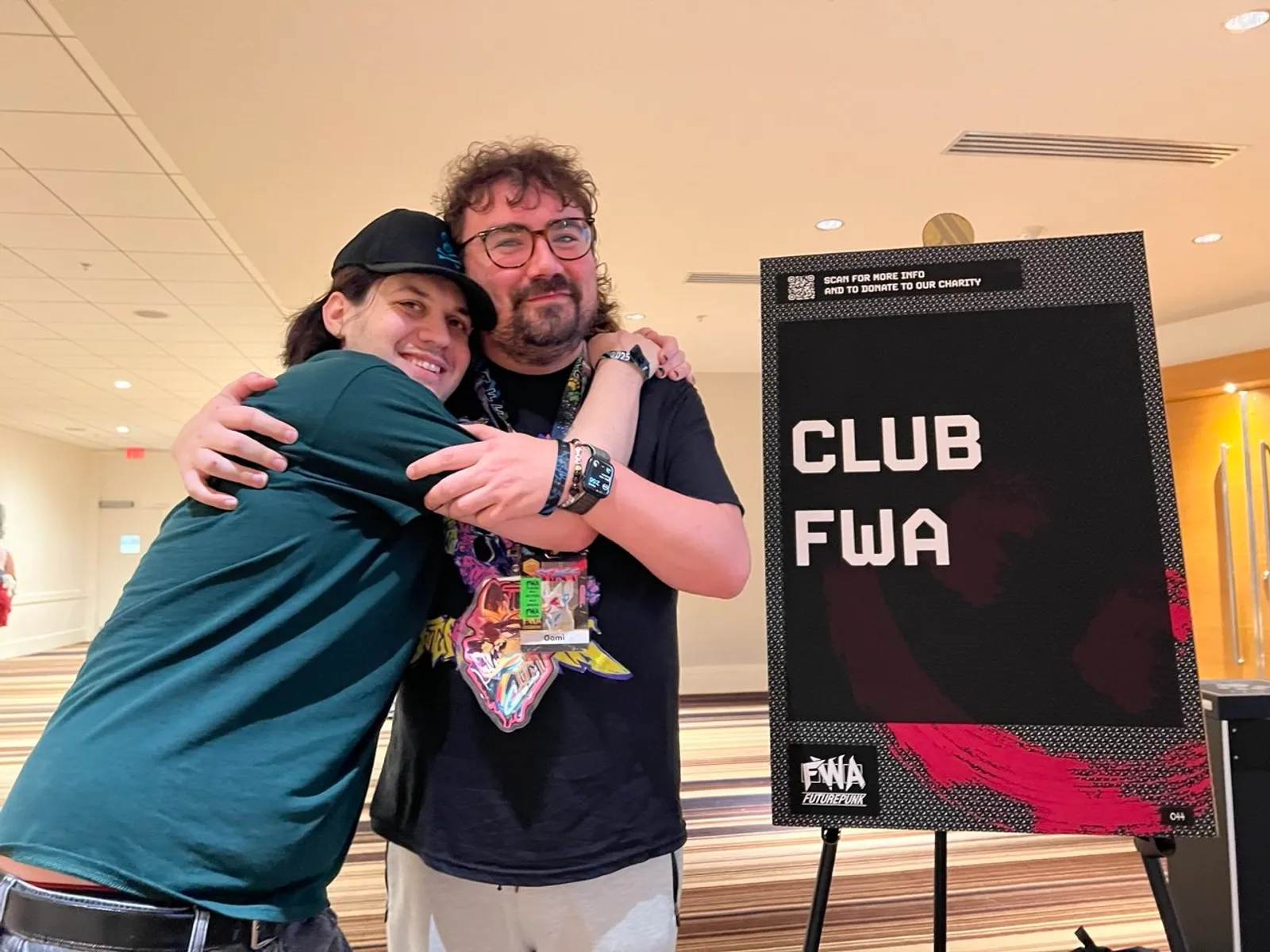
The image for this post was taken at 2am after Undead Dog played Club FWA for the first time. That’s Sen, a good friend of mine who helped me start Club FWA, and me celebrating how well Club FWA had gone.
That night is one of my fondest memories from FWA. After an incredibly stressful convention, I ended up on stage screaming and crying to Welcome to the Black Parade with a thousand other furries screaming back. I don’t think I’ll ever forget what that felt like.